

Linear Regression#
Linear regression is a fundamental and widely used statistical technique in data analysis and machine learning. It is a powerful tool for modeling and understanding the relationships between variables and make predictions on unseen data. At its core, linear regression aims to model a linear relationship between a dependent variable (the one you want to predict) and one or more independent variables (the ones used for prediction). This technique allows us to make predictions, infer associations, and gain insights into how changes in independent variables influence the target variable. Linear regression is both intuitive and versatile, making it a valuable tool for tasks ranging from simple trend analysis to more complex predictive modeling and hypothesis testing.
In this context, we will explore the concepts and applications of linear regression, its different types, and how to implement it using Python.
The Auto MPG Dataset#
We will consider the Auto MPG dataset, which contains \(398\) measurements of \(8\) different properties of different cars:
| displacement | cylinders | horsepower | weight | acceleration | model_year | origin | mpg | |
|---|---|---|---|---|---|---|---|---|
| 0 | 307.0 | 8 | 130.0 | 3504 | 12.0 | 70 | 1 | 18.0 |
| 1 | 350.0 | 8 | 165.0 | 3693 | 11.5 | 70 | 1 | 15.0 |
| 2 | 318.0 | 8 | 150.0 | 3436 | 11.0 | 70 | 1 | 18.0 |
| 3 | 304.0 | 8 | 150.0 | 3433 | 12.0 | 70 | 1 | 16.0 |
| 4 | 302.0 | 8 | 140.0 | 3449 | 10.5 | 70 | 1 | 17.0 |
| ... | ... | ... | ... | ... | ... | ... | ... | ... |
| 393 | 140.0 | 4 | 86.0 | 2790 | 15.6 | 82 | 1 | 27.0 |
| 394 | 97.0 | 4 | 52.0 | 2130 | 24.6 | 82 | 2 | 44.0 |
| 395 | 135.0 | 4 | 84.0 | 2295 | 11.6 | 82 | 1 | 32.0 |
| 396 | 120.0 | 4 | 79.0 | 2625 | 18.6 | 82 | 1 | 28.0 |
| 397 | 119.0 | 4 | 82.0 | 2720 | 19.4 | 82 | 1 | 31.0 |
398 rows × 8 columns
Here is a description of the different variables:
Displacement: The engine’s displacement (in cubic inches), which indicates the engine’s size and power.
Cylinders: The number of cylinders in the engine of the car. This is a categorical variable.
Horsepower: The engine’s horsepower, a measure of the engine’s performance.
Weight: The weight of the car in pounds.
Acceleration: The car’s acceleration (in seconds) from 0 to 60 miles per hour.
Model Year: The year the car was manufactured. This is often converted into a categorical variable representing the car’s age.
Origin: The car’s country of origin or manufacturing. Car Name: The name or identifier of the car model.
MPG (Miles per Gallon): The fuel efficiency of the car in miles per gallon. It is the variable to be predicted in regression analysis.
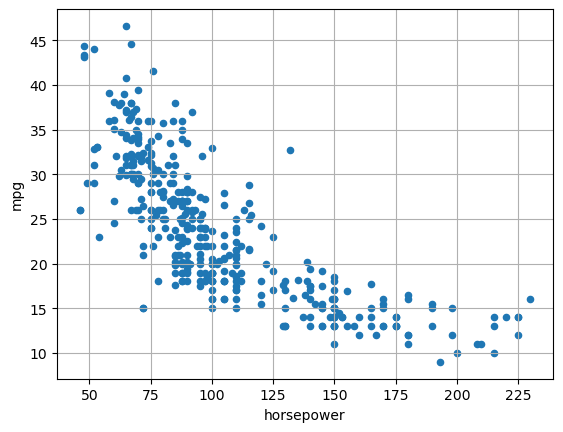
We will start by exploring the relationship between the variables horsepower and MPG. Let’s visualize the related scatterplot:
Regression Models#
Regression models, in general, aim to study the relationship between two variables, \(X\) and \(Y\), by defining a mathematical model \(f\) such that:
Here:
\(f\) is a deterministic function which can be used to predict the values of \(Y\) from the values of \(X\);
\(\epsilon\) is an error term, i.e., a variable capturing everything that is not captured by the deterministic function \(f\). It can be due to different reasons, the main of which are:
\(f\) is not an accurate deterministic function of the process. Since we don’t know the “true” function \(f\) and we are only estimating it, we may obtain a suboptimal \(f\) for which \(Y \neq f(X)\). The error term captures the differences between our predictions and the true values.
\(Y\) cannot only be predicted from \(X\), but some other variable is needed to correctly predict \(Y\) from \(X\). For instance, \(X\) could be “years of education” and \(Y\) can be “income”. While may expect that “income” is not completely predicted from “years of education”. This can happen also because we don’t always have observations for all relevant variables.
the problem has inherent stochasticity which cannot be entirely modeled within the deterministic function \(f\). For instance, consider the problem of predicting the rate of wins in poker based on the expertise of the player. The expertise surely allows to predict the rate of wins, but wins partially depend also on random factors, such as how the deck was shuffled.
Note that, often, we model \(f\) in a way that we have its analytical form. This is very powerful. If we have the analytical form of the function \(f\) which explains how \(Y\) is influenced from \(X\) (can be predicted from \(X\)), then we can really understand deeply the connection between the two variables!
The function \(f\) can take different forms. The most common one is the linear form that we will see in the next section. While the linear form is very simple (and hence we can anticipate it will be a limited model in many cases), it has the great advantage to be easy to interpret.
Simple Linear Regression#
Simple linear regression aims to model the linear relationship between two variables \(X\) and \(Y\). In our example dataset, we will consider \(X=\text{horsepower}\) and \(Y=\text{mpg}\).
Since we are trying to model a linear relationship, we can imagine a line passing through the data. The simple linear regression model is defined as:
In our example:
It is often common to introduce a “noise” variable which captures the randomness due to which the expression above is approximated and write:
As we will see later, we expect \(\epsilon\) to be small and randomly distributed.
Given the model above, we will call:
\(X\), the independent variable or regressor;
\(Y\), the dependent variable or regressed variable.
The values \(\beta_0\) and \(\beta_1\) are called coefficients or parameters of the model.
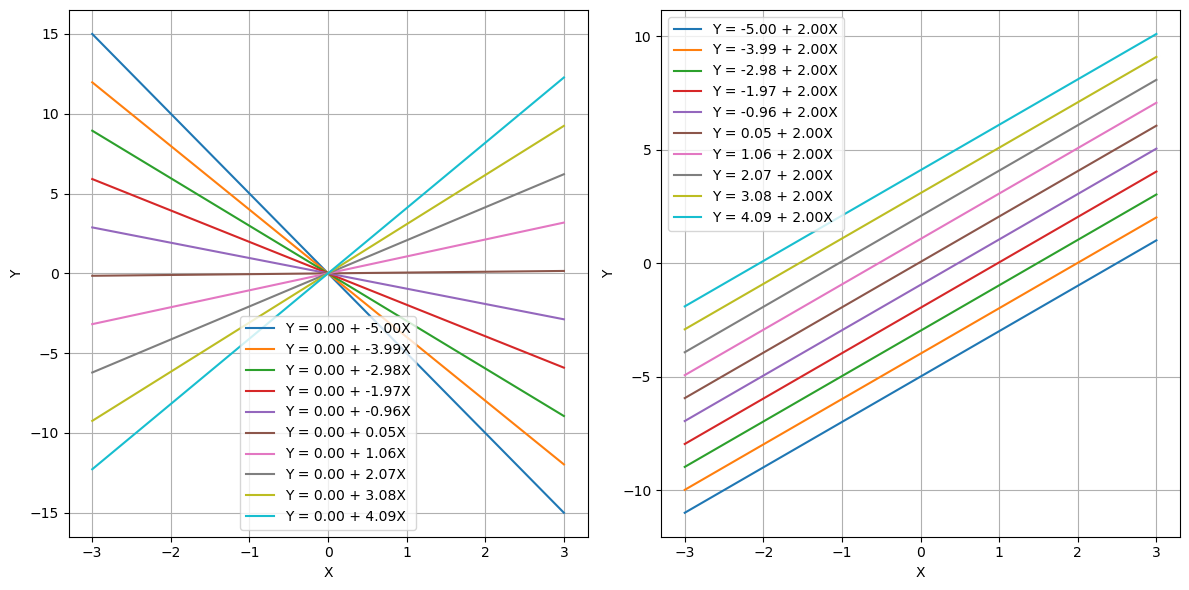
The mathematical model above has a geometrical interpretation. Indeed, specific values of \(\beta_0\) and \(\beta_1\) identify a given line in the 2D plane, as shown in the plot below:
We hence aim to estimate two appropriate values \(\hat \beta_0\) and \(\hat \beta_1\) from data in a way that they provide a model which represents well our data. In the case of our example, we expect the geometrical model to have this aspect:
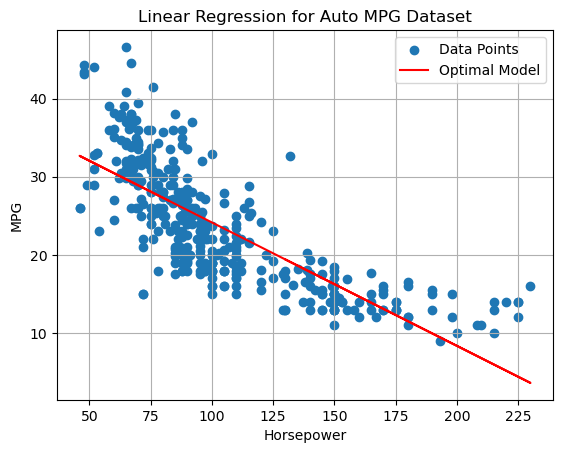
This line will also be called the regression line.
Estimating the Coefficients - Ordinary Least Squares (OLS)#
To estimate the coefficients of our optimal model, we should first define what is a good model. We will say that a good model is one that predicts well the \(Y\) variable from the \(X\) one. We already know from the example above that, since the relationship is not perfectly linear, the model will make some mistakes.
Let \(\{(x_i,y_i)\}\) be our set of observations. Let
be the prediction of the model for the observation \(x_i\). For each data point \((x_i,y_i)\), we will define the deviation of the prediction from the \(y_i\) value as follows:
We use the symbol \(e\) for error and also call these numbers the residuals, as they are the differences (or residuals) between our prediction and the ground truth value.
These numbers will be positive or negative based on whether we underestimate or overestimate the \(y_i\) values, while they will be zero when the prediction is perfect.
As a global error indicator for the model, given the data, we will define the residual sum of squares (RSS) as:
or equivalently:
This number will be the sum of the square values of the dashed segments in the plot below:
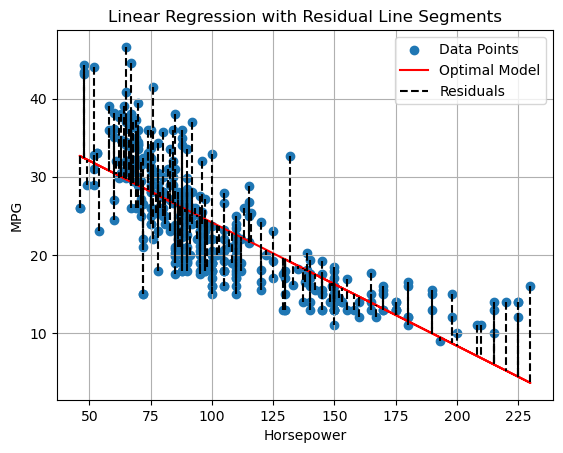
Intuitively, if we minimize these numbers, we will find the line which best fits the data.
We can obtain estimates for \(\hat \beta_0\) and \(\hat \beta_1\) by minimizing the RSS using an approach called ordinary least squares.
We can write the RSS as a function of the parameters to estimate:
This is also called a cost function or loss function.
We aim to find:
The minimum can be found setting:
Doing the math, it can be shown that:
Empirical Risk Minimization#
It is worth noting that we can obtain the same result by following an Empirical Risk Minimization scheme.
In particular, we can choose to use their squared values as our cost function:
and define the Empirical Risk as follows:
where \(h=f\).
Note that, since:
we can solve the optimization problem with Ordinary Least Squares (OLS) (the same method we used previously to minimize RSS).
From a learning perspective, solving the optimization problem \(\hat h = \underset{h \in \mathcal{H}}{\mathrm{arg\ min}}\ R_{emp}(h)\) corresponds to finding the optimal set of parameters \(\mathbf{\beta}\) minimizing the empirical risk, which corresponds to minimizing the Residual Sum of Squares, as previously defined.
Interpretation of the Coefficients of Linear Regression#
Using the formulas above, we find the following values for the example above:
beta_0: 39.94
beta_1: -0.16
These parameters identify the following line:
The plot below shows the line on the data:
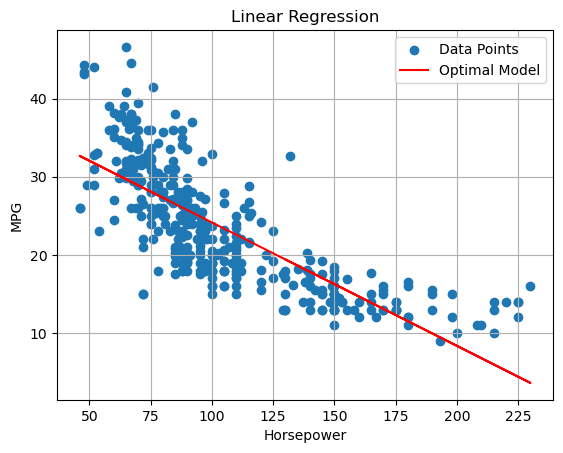
Apart from the geometric interpretation, the coefficients of a linear regressor have an important statistical interpretation. In particular:
The intercept \(\beta_0\) is the value of \(y\) that we get when the input value \(x\) is equal to zero \(x=0\) (i.e., \(f(0)\)). This value may not always make sense. For instance, in the example above, we have: \(\beta_0 = 39.94\), which means that, when the horsepower is \(0\), then the consumption in mpg is equal to \(39.94\).
The coefficient \(\beta_1\) indicates the steepness of the curve. If \(\beta_1\) is large, then the curve is steep. This indicates that a small change in \(x\) is associated to a large change in \(y\). In general, we can see that:
which reveals that when we observe an increment of one unit of x, we observe an increment of \(\beta_1\) units in y. In our example, \(\beta_1=-0.15\), hence we can say that, for cars with one additional unit of horsepower, we observe an drop in mpg \(-0.15\) units.
Accuracy of the Coefficient Estimates#
Recall that we are trying to model the relationship between two random variables \(X\) as \(Y\) with a simple linear model:
This means that, once we find appropriate values of \(\beta_0\) and \(\beta_1\), we expect these to summarize the linear relationship in the population or the population regression line. Also, recall that these values are obtained using two formulas which are based on realizations of \(X\) of \(Y\) and can be hence seen as estimators:
We now recall that, being estimates, they provide values related to a given realization of the random variables.
Let us consider an ideal population for which:
Ideally, given a sample from the population, we expect to obtain \(\hat \beta_0 \approx 1\) and \(\hat \beta_1 \approx 2\). In practice, different samples may lead to different estimates and hence different regression lines, as shown in the plot below:
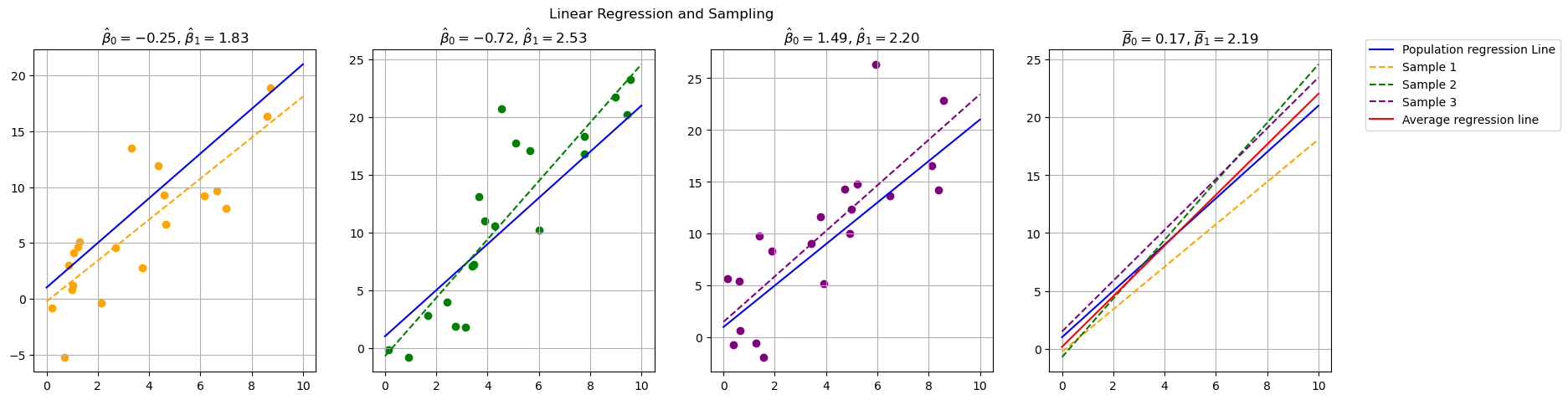
Each of the first three subplots shows a different sample drawn from the population, with its corresponding estimated regression line, along with the true population regression line. The last subplot compares the different estimated lines with the population regression line and the average regression line (in red). Coefficient estimates are shown in the subplot titles.
As can be noted, each estimate can be inaccurate, while the average regression line is very close to the population regression line. This is due to the fact that our estimators for the parameters of the regression coefficients have non-zero variance. In practice, it can be shown that these estimators are unbiased (hence the average regression line is close to the population line).
Confidence Intervals of the Regression Coefficients#
Since the formulas to compute regression parameters can be seen as estimators, we can compute standard errors and confidence intervals.
For instance, for our model
We will have the following confidence interval at a \(95\%\) confidence level (which is a common CL):
COEFFICIENT |
STD ERROR |
CONFIDENCE INTERVAL |
|
|---|---|---|---|
\(\beta_0\) |
39.94 |
0.717 |
\([38.53, 41.35]\) |
\(\beta_1\) |
-0.1578 |
0.006 |
\([-0.17, -0.15]\) |
From the table above, we can say that:
The value of
mpgforhorsepower=0lies somewhere between \(38.53\) and \(41.35\);An increase of
horsepowerby one unit is associated to a decrease ofmpgbetween \(-0.17\) and \(-0.15\).
It is also common to see plots like the following one:
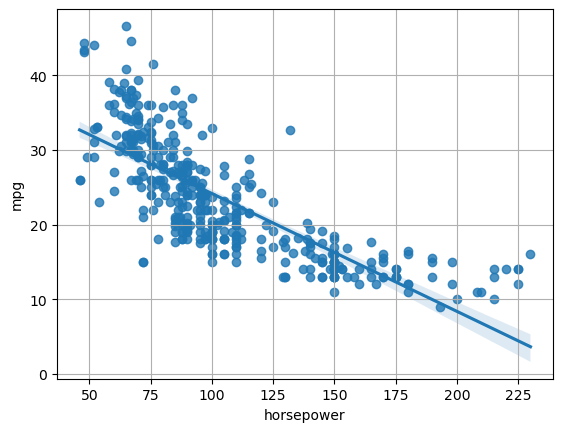
In the plot above, the shading around the line illustrates the variability induced by the confidence intervals estimated for the coefficients.
Statistical Tests for the Significance of Coefficients#
Seeing the aforementioned formulas as estimators also allows to perform hypothesis tests on the coefficients. In practice, it is common to perform a statistical test to assess whether the coefficient \(\beta_1\) is significantly different from zero. It is interesting to check this because, if \(\beta_1\) was equal to zero, then there would not be any correlation between the variables (and hence the linear regressor would not be useful). Indeed, if \(\beta_1=0\):
Hence \(Y\) cannot be predicted from \(X\) and the two variables are not associated.
The null hypothesis of the test is as follows:
While the alternative hypothesis is formulated as follows:
We won’t see the mathematical details of this test, but it works as usual: we compute some statistic \(t\) following a known distribution (a t-Student distribution in this case), then compute a p-value and reject the null hypothesis if this is under the significance level \(p < \alpha\) (often set to \(\alpha=0.05\)).
A similar test is conducted to check whether \(\beta_0\) is significantly different from zero. But in this case it is not a big deal if the test fails as \(\beta_0=0\) is a perfectly reasonable result (the regression line passes through the origin).
Let’s see the updated table from the same example:
COEFFICIENT |
STD ERROR |
t |
P>|t| |
CONFIDENCE INTERVAL |
|
|---|---|---|---|---|---|
\(\beta_0\) |
\(39.94\) |
\(0.717\) |
\(55.66\) |
\(0\) |
\([38.53, 41.35]\) |
\(\beta_1\) |
\(-0.1578\) |
\(0.006\) |
\(-24.49\) |
\(0\) |
\([-0.17, -0.15]\) |
From the table above, we can conclude that both \(\beta_0\) and \(\beta_1\) are significantly different than \(0\) (the p-value is equal to zero). This can also be noted by the fact that the confidence intervals do not contain the zero number.
Assessing Model Accuracy#
The hypothesis tests (like the t-test for \(\beta_1\)) tell us if a statistically significant relationship exists. They do not, however, tell us how well the model fits the data or how accurate its predictions are.
To measure performance, we use different metrics that generally fall into two categories, aligning with our “two goals”:
Metrics for Understanding (Goodness-of-Fit): These are used in the “Statistical” approach to measure how well the model explains the data it was trained on. (e.g., RSE, R²)
Metrics for Prediction (Predictive Accuracy): These are used in the “Machine Learning” approach to measure how well the model performs on new, unseen data. (e.g., MSE, RMSE, MAE)
The Building Block: Residuals and RSS#
All regression metrics are built upon the residuals—the errors from the model. A residual (\(e_i\)) is the difference between the observed value (\(y_i\)) and the predicted value (\(\hat{y}_i\)):
The Residual Sum of Squares (RSS) which we already saw is the foundational quantity that OLS (Ordinary Least Squares) minimizes. It is the sum of all squared residuals:
Metrics for Understanding (Goodness-of-Fit)#
When our goal is understanding (inference), we typically evaluate the model on the entire dataset it was trained on.
1. Residual Standard Error (RSE)#
The RSE is the statistical estimate of the standard deviation of the irreducible error, \(\epsilon\). It measures the “typical” error of the model.
Why \(n-2\)? We divide by the “degrees of freedom” (\(n-2\)) because we estimated two parameters (\(\beta_0\) and \(\beta_1\)). This makes RSE an unbiased estimate of \(\sigma\) (the standard deviation of \(\epsilon\)).
Interpretation: RSE is an absolute measure of the model’s “lack of fit,” expressed in the same units as \(Y\). A smaller RSE means the model fits the data better.
To know if an RSE value is “good,” you must compare it to the scale of \(Y\).
Example: For our
mpgdata, \(RSE = 4.91\). The mean value ofmpgis \(\overline{y} = 23.52\). This means our model’s typical error (\(4.91\)) is about 20% of the average value, which may be acceptable or not, depending on the context.
2. The \(R^2\) Statistic#
The RSE is an absolute measure. It’s often more useful to have a relative measure that tells us what proportion of the data’s variance our model can explain. This is the \(R^2\) (Coefficient of Determination).
To calculate \(R^2\), we first define a “baseline” model that just predicts the average \(Y\) for every \(X\): $\(\hat{y}_{baseline} = \overline{y}\)$
The error of this “dumb” model is the Total Sum of Squares (TSS): $\(TSS = \sum_{i=1}^n(y_i-\overline y)^2\)$
TSS measures the total variance in \(Y\) (before any regression).
RSS measures the unexplained variance in \(Y\) (what’s left over after regression).
The \(R^2\) statistic is the proportion of total variance that is “explained” by the model:
Interpretation: \(R^2\) is a value between 0 and 1 (or 0% to 100%).
\(R^2 = 0\): Our model is no better than just guessing the mean (\(RSS = TSS\)).
\(R^2 = 1\): Our model perfectly explains all the variance (\(RSS = 0\)).
Example: For our
mpgdata, \(R^2 = 0.61\). This means “61% of the variance inmpgcan be explained byhorsepower.”
For simple linear regression (one \(X\)), \(R^2\) is also equal to the square of the Pearson correlation coefficient: \(R^2 = \rho^2\).
Visual Examples#
The plot below shows examples of linear regression fits with the different evaluation measures that we saw:
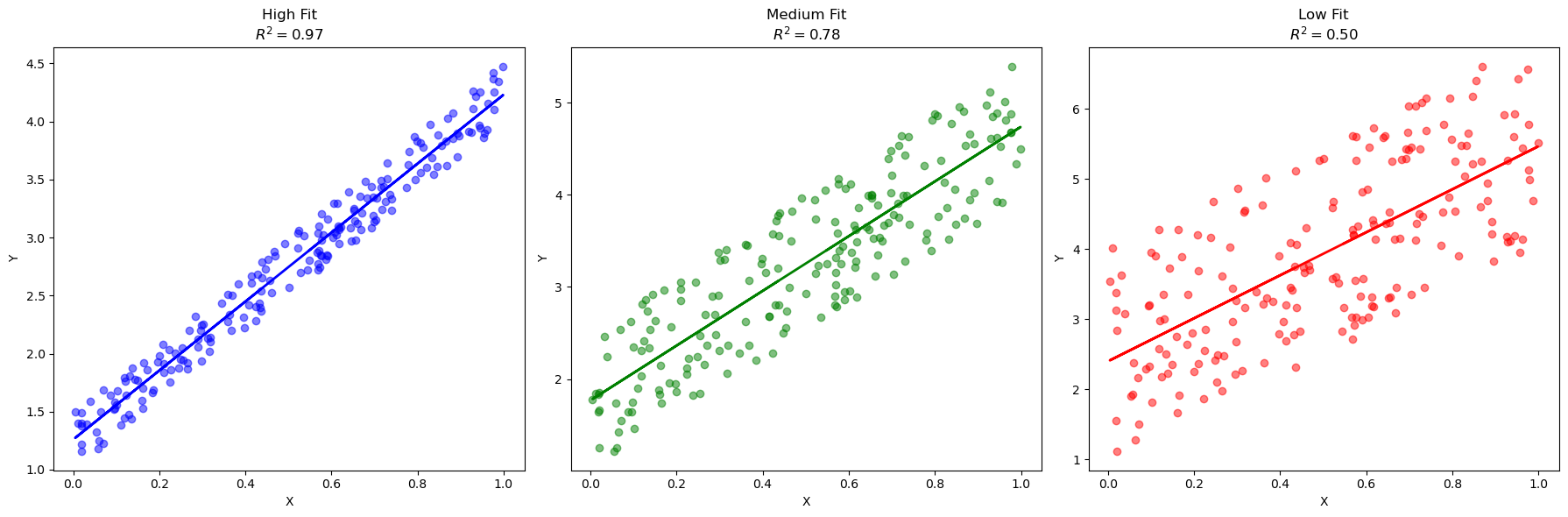
Diagnostic Plots: Checking Model Validity#
The metrics above (\(R^2\), \(RMSE\)) are “scoring” metrics. They give you a single number to summarize how much error you have.
However, they don’t tell you why you have error, or if your model is fundamentally invalid. A model can have a “good” \(R^2\) but still be flawed. We use residual plots as diagnostic tools to check this.
1. The Residuals vs. Fitted Plot#
This is the most important diagnostic plot. We plot the Residuals (\(e_i\)) on the y-axis against the Fitted (Predicted) Values (\(\hat{y}_i\)) on the x-axis.
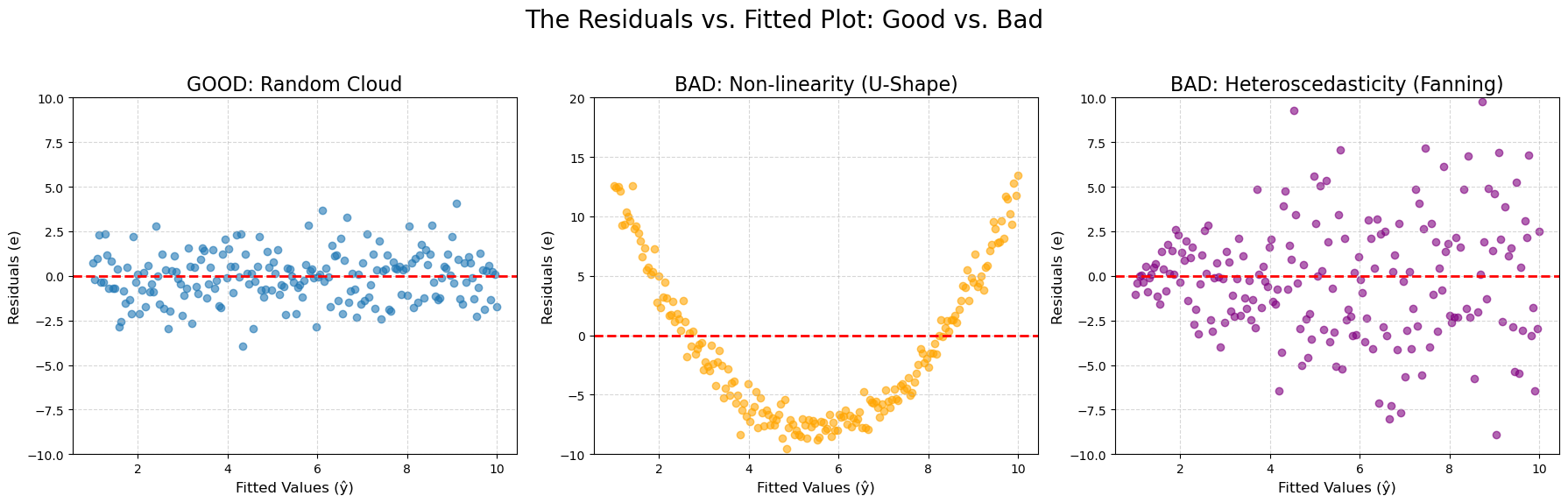
What we want to see: A boring, random cloud of points with no pattern, centered around the \(y=0\) line. This indicates our model has captured the pattern and the remaining errors are just random noise.
What we don’t want to see (Red Flags):
A “U-Shape” or any Clear Pattern: This means our model is wrong. The relationship between \(X\) and \(Y\) was not linear, and our simple linear model has failed to capture the true non-linear pattern.
Diagnosis: Violates the Linearity assumption.
Fix: You need a more complex model (e.g., polynomial regression).
A “Fanning” or “Cone” Shape: The residuals get bigger (more spread out) as the predicted value \(\hat{y}\) gets bigger.
Diagnosis: This is called Heteroscedasticity (non-constant variance).
Problem: This violates a core assumption of linear regression. It means our p-values and confidence intervals are unreliable because the model is less accurate for high-value predictions.
The figure below shows some examples of what to expect:
2. The Q-Q Plot (Quantile-Quantile Plot)#
This is a plot used to check if the residuals are normally distributed. This is another key assumption for all our statistical tests (p-values, t-statistics).
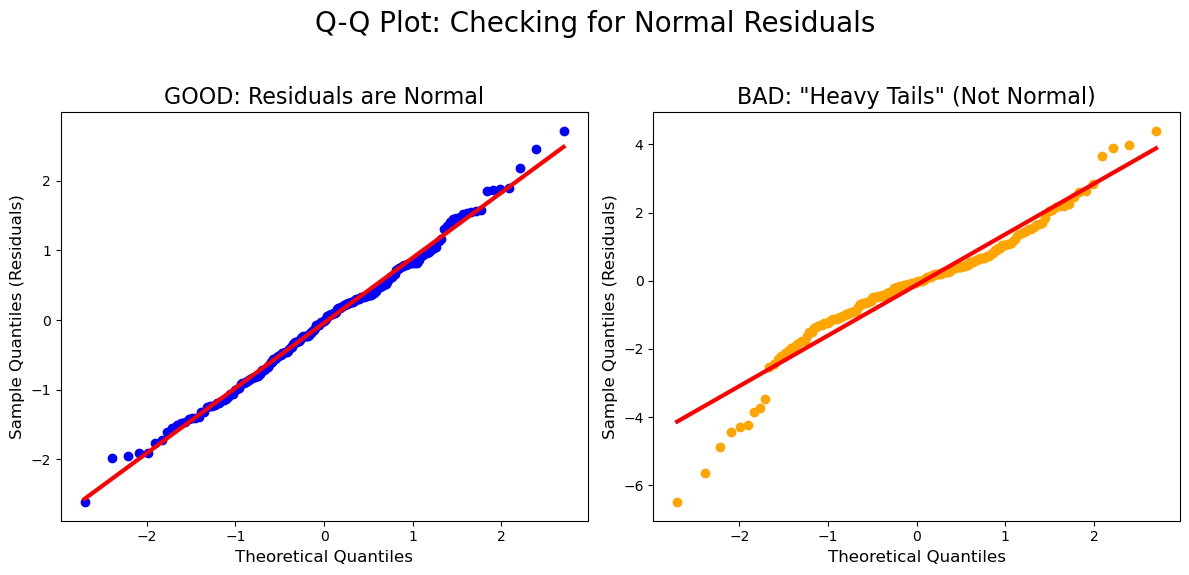
Purpose: To check the Normality assumption.
How to read it: If the residuals are truly normally distributed, the points will fall perfectly along the diagonal line.
Problem: If the points “S-curve” or peel away from the line, it means the residuals are not normal, and our p-values and confidence intervals may be inaccurate.
The figure below shows examples of “good” and “bad” residuals:
Multiple Linear Regression#
In the MPG example, we saw that about \(61\%\) of the variance in \(Y\) was explained by the model. One may wonder why about \(39\%\) of the variance could not be explained. Some common reasons may be:
There is stochasticity in the data which prevents us to learn an accurate function to predict \(Y\) from \(X\);
The relationship between \(X\) and \(Y\) is far from linear, so we cannot predict \(Y\) accurately;
The prediction of \(Y\) also depends on other variables.
While in general the unexplained variance is due to a combination of the aforementioned factors, the third one is often very common and relatively easy to fix. In our case, we are trying to predict mpg from horsepower. However, we can easily imagine how other variables may contribute to the estimation of mpg. For instance, two cars with the same horsepower but different weight may have different values of mpg. We can hence try to find a model with also uses weight to predict mpg. This is simply done by adding an additional coefficient for the new variable:
The obtained model is called multiple linear regression. If we fit this model (we will see how to estimate coefficients in this case), we obtain the following \(R^2\) value:
An increment of \(+0.1\)!
In general, we can include as many variables as we think is relevant to add and define the following model:
For instance, the following model:
Has an \(R^2\) value of:
Geometrical Interpretation#
The multiple regression model based on two variable has a geometrical interpretation. Indeed, the equation:
identifies a plane in the 3D space. We can visualize the plane identified by the \(mpg = \beta_0 + \beta_1 horsepower + \beta_2 weight\) model as follows:
/var/folders/cs/p62_d78d49n3ddj0xlfh1h7r0000gn/T/ipykernel_70719/9283374.py:11: FutureWarning: The 'delim_whitespace' keyword in pd.read_csv is deprecated and will be removed in a future version. Use ``sep='\s+'`` instead
  auto_df = pd.read_csv(url, delim_whitespace=True, names=column_names)
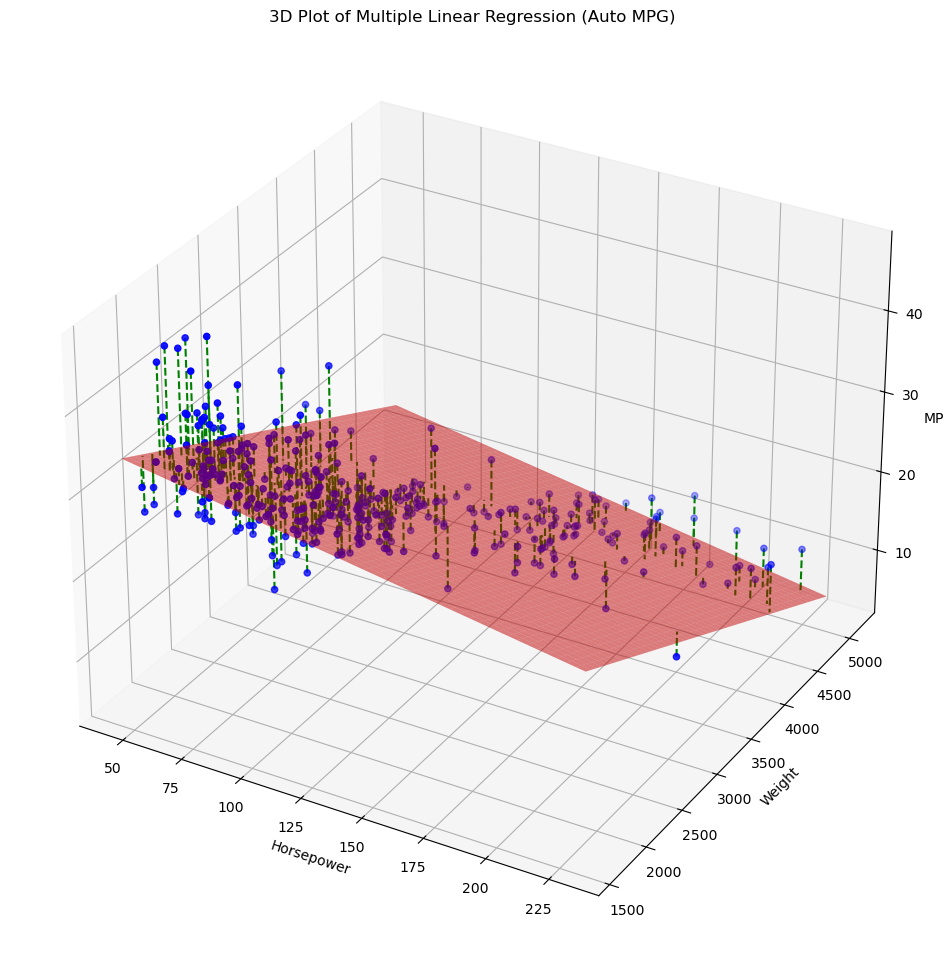
The dashed lines indicate the residuals. The best fit of the model minimizes again the sum of squared residuals. This model makes predictions selecting the \(Z\) value which intersect the plane for given values of \(X\) and \(Y\).
In general, when we consider \(n\) variables, the linear regressor will be a (n-1)-dimensional hyperplane in the n-dimensional space.
Statistical Interpretation#
The statistical interpretation of a multiple linear regression model is very similar to the interpretation of a simple linear regression model. Given the general model:
we can interpret the coefficients as follows:
The value of \(\beta_0\) indicates the value of \(y\) when all independent variables are set to zero;
The value of \(\beta_i\) indicates the increment of \(y\) that we expect to see when \(x_i\) increments by one unit, provided that all other values \(x_j | j\neq i\) are constant.
In the considered example:
we obtain the following estimates for the coefficients:
\(\hat \beta_0\) |
\(\hat \beta_1\) |
\(\hat \beta_2\) |
|---|---|---|
\(45.64\) |
\(-0.05\) |
\(-0.01\) |
We can interpret these estimates as follows:
Cars with zero
horsepowerand zeroweightwill have anmpgof \(45.64\) (\(\approx 19.4 Km/l\)).An increment of one unit of
horsepoweris associated to a decrement ofmpgof \(-0.05\) units, provided thatweightis constant. This makes sense: cars with morehorsepowerwill probably consume more fuel.An increment of one unit of
weightis associated to a decrement ofmpgof-0.01units, provided thathorsepoweris constant. This makes sense: heavier cars will consume more fuel.
Let’s compare the estimates above with the estimates of our previous model:
In that case, we obtained:
\(\hat \beta_0\) |
\(\hat \beta_1\) |
|---|---|
\(39.94\) |
\(-0.16\) |
We can note that the coefficients are different. This happens because, when we add more variables, the model explains variance in a different way. If we think more about it, this is coherent with the interpretation of the coefficients. Indeed:
\(39.94\) is the expected value of
mpgwhenhorsepower=0, but all other variables have unknown values. \(45.64\) is the expected value ofmpgwhenhorsepower=0andweight=0. This is different, as in the second case we are (virtually) looking at a subset of data for which both horsepower and weight are zero, while in the first case, we are only looking at data for whichhorsepower=0, butweightcan be any value. In some sense, we can see \(39.94\) as an average value for different values ofweight(and all other unobserved variables).\(-0.16\) is the expected increment of
mpgwhen we observe an increment of one unit ofhorsepowerand we don’t know anything about the values of the other variables. \(-0.05\) is the expected increment ofmpgwhenhorsepowerandweightare held constant, so, again, we are (virtually) looking at a different subset of the data in which the relationship betweenmpgandhorsepowermay be a bit different.
Note that, also in the case of multiple regression, we can estimate confidence intervals and perform statistical tests. In our example, we will get this table:
COEFFICIENT |
STD ERROR |
t |
P>|t| |
CONFIDENCE INTERVAL |
|
|---|---|---|---|---|---|
\(\beta_0\) |
\(45.64\) |
\(0.793\) |
\(57.54\) |
\(0\) |
\([44.08, 47.20]\) |
\(\beta_1\) |
\(-0.05\) |
\(0.011\) |
\(-4.26\) |
\(0\) |
\([-0.07, -0.03]\) |
\(\beta_2\) |
\(-0.01\) |
\(0.001\) |
\(-11.53\) |
\(0\) |
\([-0.007, -0.005]\) |
Estimating the Regression Coefficients#
Given the general model:
We can define our cost function again as the residual sum of squares:
Where \(m\) is the total number of observations and \(x_j^{(i)}\) is the \(j^{th}\) variable (\(x_j\)) of the \(i^{th}\) observations.
The \(\hat \beta_0,\ldots,\hat \beta_n\) values that minimize the loss function above are the multiple least square coefficient estimates.
To find these optimal values, it is convenient to use matrix notation. Given \(m\) observations, we will have \(m\) equations:
We can write the \(m\) equations in matrix form as follows:
where:
The matrix \(\mathbf{X}\) is s design matrix.
In the notation above, we want to minimize:
It can be shown that, by the least squares method, the RSS is minimized by the estimate:
The F-Test#
When fitting a multiple linear regressor, it is common to perform a statistical test to check whether at least one of the regression coefficients is significantly different from zero (in the population). This test is called an \(F-test\). We define the null and alternative hypotheses as follows:
The null hypothesis (the one we want to reject with this test) is that all coefficients are zero in the population. If this is true, than the multiple regressor is not reliable and we should discard it. Note that we exclude \(\beta_0\) from these coefficients because it represents the position of the regression line (intercept) and does not denote correlation. The alternative hypothesis is that at least one of the coefficients is different from zero.
We will not see the mathematical details, but in this case, we compute an F-statistic which follows a F-distribution.
The test is hence carried out as usual, finding a p-value which indicates the probability to observe a statistic larger than the observed one if all regression coefficients are zero in the population.
In our example of regressing mpg from horsepower and weight, we will find:
\(R^2\) |
F-statistic |
Prob(F-statistic) |
|---|---|---|
0.706 |
467.9 |
3.06e-104 |
This indicates that the regressor is statistically relevant as the p-value (Prob(F-statistic)) is very small (under the significance level \(\alpha = 0.05\)).
Variable Selection by Backward Elimination#
Let’s now try to fit a multiple linear regressor on our dataset by including all variables. Our dependent variable will be mpg, while the set of dependent variables will be:
['displacement' 'cylinders' 'horsepower' 'weight' 'acceleration'
 'model_year' 'origin']
We obtain the following measures of fit:
\(R^2\) |
F-statistic |
Prob(F-statistic) |
|---|---|---|
0.821 |
252.4 |
2.04e-139 |
The regressor has a good \(R^2\) and the p-value of the F-test is very small. We can conclude that there is some relationship between the independent variables and the dependent one.
The estimates of the regression coefficients will be:
| coef | std err | t | P>|t| | [0.025 | 0.975] | |
|---|---|---|---|---|---|---|
| Intercept | -17.2184 | 4.644 | -3.707 | 0.000 | -26.350 | -8.087 |
| horsepower | -0.0170 | 0.014 | -1.230 | 0.220 | -0.044 | 0.010 |
| weight | -0.0065 | 0.001 | -9.929 | 0.000 | -0.008 | -0.005 |
| displacement | 0.0199 | 0.008 | 2.647 | 0.008 | 0.005 | 0.035 |
| cylinders | -0.4934 | 0.323 | -1.526 | 0.128 | -1.129 | 0.142 |
| acceleration | 0.0806 | 0.099 | 0.815 | 0.415 | -0.114 | 0.275 |
| model_year | 0.7508 | 0.051 | 14.729 | 0.000 | 0.651 | 0.851 |
| origin | 1.4261 | 0.278 | 5.127 | 0.000 | 0.879 | 1.973 |
From the table, we can see that not all predictors have a p-value below the significance level \(\alpha=0.05\). In particular:
horsepowerhas a large p-value of \(0.22\);cylindershas a large p-value of \(0.128\);accelerationhas a large p-value of \(0.415\).
This means that, within the current regressor, there is no meaningful relationship between these variables and mpg. A legitimate question is
How is it possible that
horsepoweris not associated tompgin this regressor if it was associated to it before?!
However, we should recall that, when we consider a different set of variables, the interpretation of the coefficients changes. So, even if in the previous models, horsepower was correlated to mpg, now it is not correlated anymore. We can imagine that the relationship between these variables is now explained by the other variables which we have introduced.
Even if the model is statistically significant, it does make sense to get rid of the variables with poor relationships with mpg. After all, if we remove a variable, the estimates of the other coefficients may change.
A common way to remove these variables is by backward selection or backward elimination. This consists in iteratively removing the variable with the largest p-value. We remove one variable at a time and re-compute the results, iterating until all variables have a small p-value.
let’s start by removing acceleration. This is the result:
| coef | std err | t | P>|t| | [0.025 | 0.975] | |
|---|---|---|---|---|---|---|
| Intercept | -15.5635 | 4.175 | -3.728 | 0.000 | -23.773 | -7.354 |
| horsepower | -0.0239 | 0.011 | -2.205 | 0.028 | -0.045 | -0.003 |
| weight | -0.0062 | 0.001 | -10.883 | 0.000 | -0.007 | -0.005 |
| displacement | 0.0193 | 0.007 | 2.579 | 0.010 | 0.005 | 0.034 |
| cylinders | -0.5067 | 0.323 | -1.570 | 0.117 | -1.141 | 0.128 |
| model_year | 0.7475 | 0.051 | 14.717 | 0.000 | 0.648 | 0.847 |
| origin | 1.4282 | 0.278 | 5.138 | 0.000 | 0.882 | 1.975 |
Note that the coefficients have changed. We now remove cylinders, which has the largest p-value of \(0.117\):
| coef | std err | t | P>|t| | [0.025 | 0.975] | |
|---|---|---|---|---|---|---|
| Intercept | -16.6939 | 4.120 | -4.051 | 0.000 | -24.795 | -8.592 |
| horsepower | -0.0219 | 0.011 | -2.033 | 0.043 | -0.043 | -0.001 |
| weight | -0.0063 | 0.001 | -11.124 | 0.000 | -0.007 | -0.005 |
| displacement | 0.0114 | 0.006 | 2.054 | 0.041 | 0.000 | 0.022 |
| model_year | 0.7484 | 0.051 | 14.707 | 0.000 | 0.648 | 0.848 |
| origin | 1.3853 | 0.277 | 4.998 | 0.000 | 0.840 | 1.930 |
All variables now have an acceptable p-value (\(\alpha=0.05\)). We are done. Note that, by removing the two variables, horsepower now has an acceptable p-value. This indicates that one of the removed variables was redundant with respect to horsepower.
Collinearity and the Instability of Least Squares#
Let’s reflect again on the issue we saw in our model: the horsepower p-value was significant in the simple model but became non-significant (\(p > 0.05\)) in the multiple regression. This isn’t a contradiction; it’s a classic symptom of collinearity.
Collinearity is a high linear correlation between two predictor variables. The more general (and common) problem is multicollinearity, which occurs when one predictor \(X_j\) can be accurately predicted by a linear combination of other predictors in the model (e.g., \(X_j \approx \beta_0 + \beta_1 X_1 + \ldots\)).
The primary problem with multicollinearity is that it makes our coefficient estimates unstable and unreliable. The standard errors of the coefficients for the correlated predictors become massively inflated. This is what we saw: horsepower became non-significant because weight (which is highly correlated with it) “stole” all of its explanatory power.
This instability can be explained by looking directly at the mathematical solution for the OLS coefficients \(\hat{\beta}\):
The key to this entire equation is the \((X^T X)^{-1}\) term, which is the inverse of the “design matrix.” The \(X^T X\) matrix is, in essence, a matrix of the covariances between all of our predictor variables.
Perfect Collinearity (Singularity): If one variable is a perfect linear combination of another (e.g., \(X_1 = 2 \cdot X_2\)), the columns of \(X\) are not linearly independent. This causes the \(X^T X\) matrix to be singular, meaning its determinant is zero and its inverse does not exist. There is no unique solution for \(\hat{\beta}\).
Multicollinearity (Ill-Conditioning): In our
mpgcase, the variables aren’t perfectly correlated, but highly correlated. This means \(X^T X\) is not perfectly singular, but it is “ill-conditioned” or “near-singular”. Its determinant is almost zero.
When we compute the inverse, \((X^T X)^{-1}\), we are “dividing by almost zero.” This causes the numbers inside the inverse matrix to explode, becoming massive.
The formula for the standard error of each coefficient \(\hat{\beta}_j\) is directly proportional to the values in this inverse matrix. Therefore, if the values in \((X^T X)^{-1}\) are huge, the standard errors for our coefficients become inflated. This leads to a tiny t-statistic (\(t = \hat{\beta}_j / SE(\hat{\beta}_j)\)) and a massive, non-significant p-value. This is exactly what happened to horsepower.
When statsmodels (or numpy) encounters a perfectly singular \(X^T X\) matrix (e.g., you forget to drop one dummy variable, creating perfect multicollinearity), it cannot compute the standard inverse.
Instead of crashing, it computes the Moore-Penrose Pseudoinverse, denoted as \((X^T X)^+\). This is a generalization of the inverse that finds the one solution \(\hat{\beta}\) that has the smallest \(\ell_2\)-norm. In practice, statsmodels will identify this redundancy, report that the matrix is singular, and often arbitrarily set one of the redundant variable’s coefficients to zero to provide a stable (but not unique) set of coefficients.
Adjusted \(R^2\)#
While in the case of simple regression we saw that \(R^2=\rho(x,y)^2\) (where \(\rho\) is the correlation coefficient), in the case of multiple regression, it turns out that:
In general, having more variables in the linear regressor will reduce the error term and increase the covariance between \(Y\) and \(\hat Y\), hence increasing the \(R^2\). However, in general having a small increase in \(R^2\) when we add a new variable may not be good. Indeed, we could prefer a simpler model with a slightly smaller \(R^2\) value.
This is again a problem of bias-variance tradeoff.
To express this, we can compute the adjusted \(R^2\) as follows:
Where \(m\) is the number of data points and \(n\) is the number of independent variables. The \(\overline R^2\) re-balances the \(R^2\) accounting for the introduction of additional variables.
For instance the last model we fit has an \(R^2=0.820\) and \(\overline R^2=0.818\). In general, when using multiple regressor and especially for variable selection, it is good practice to use the adjusted \(R^2\) rather than standard \(R^2\).
Qualitative Predictors#
So far, we have studied relationships between continuous variables. In practice, linear regression allows to also study relationship between continuous dependent variables and qualitative independent variables. We will consider another dataset similar to the Auto MPG dataset:
| mpg | horsepower | fuelsystem | fueltype | length | cylinders | |
|---|---|---|---|---|---|---|
| 0 | 21 | 111.0 | mpfi | gas | 168.8 | 4 |
| 1 | 21 | 111.0 | mpfi | gas | 168.8 | 4 |
| 2 | 19 | 154.0 | mpfi | gas | 171.2 | 6 |
| 3 | 24 | 102.0 | mpfi | gas | 176.6 | 4 |
| 4 | 18 | 115.0 | mpfi | gas | 176.6 | 5 |
| ... | ... | ... | ... | ... | ... | ... |
| 200 | 23 | 114.0 | mpfi | gas | 188.8 | 4 |
| 201 | 19 | 160.0 | mpfi | gas | 188.8 | 4 |
| 202 | 18 | 134.0 | mpfi | gas | 188.8 | 6 |
| 203 | 26 | 106.0 | idi | diesel | 188.8 | 6 |
| 204 | 19 | 114.0 | mpfi | gas | 188.8 | 4 |
205 rows × 6 columns
In this case, besides having numerical variables, we also have qualitative ones such as fuelsystem and fueltype. Let’s see what are their unique values:
fuelsystem: ['mpfi' '2bbl' 'mfi' '1bbl' 'spfi' '4bbl' 'idi' 'spdi']
fueltype: ['gas' 'diesel']
We will not see the meaning of all the values of fuelsystem, while the values of fueltype are self-explanatory.
Predictors with Only Two Levels#
We will first see the case in which qualitative predictors only have two levels. To handle these as independent variables, we can define a new dummy variable which will encode \(1\) as one of the two levels and \(0\) as the other one. For instance, we can introduce a fueltype[T.gas] variable defined as follows:
If we fit the model:
We obtain an \(R^2=0.661\) with \(Prob(F-statistic) \approx 0\) and the following estimates for the regression parameters:
| coef | std err | t | P>|t| | [0.025 | 0.975] | |
|---|---|---|---|---|---|---|
| Intercept | 41.2379 | 1.039 | 39.705 | 0.000 | 39.190 | 43.286 |
| fueltype[T.gas] | -2.7658 | 0.918 | -3.013 | 0.003 | -4.576 | -0.956 |
| horsepower | -0.1295 | 0.007 | -18.758 | 0.000 | -0.143 | -0.116 |
How do we interpret this result?
The value of
mpgwhenhorsepower=0fueltype=diesel(i.e.,fueltype[T.gas]=0) is \(41.2379\);An increase of one unit of
horsepoweris associated to a decrease of \(0.1295\) units ofmpgprovided thatfueltype=diesel;For gas vehicles we expect to see a decrease of
mpgequal to \(2.7658\) with respect to diesel vehicles.
Predictors with More than Two Levels#
When predictors have \(n\) levels, we need to introduce multiple dummy variables. Specifically, we need to introduce \(n-1\) binary variables. For instance, if the levels of the variable income are low, medium and high, we could introduce two variables income[T.low] and income[T.medium]. These are sufficient to express all possible values of income as shown in the table below:
|
|
|
|---|---|---|
|
1 |
0 |
|
0 |
1 |
|
0 |
0 |
Note that we could have introduced a new variable income[T.high] but this would have been redundant and so correlated to the other two variables, which is something we know we have to avoid in linear regression.
If we fit the model which predicts mpg from horsepower and fuelsystem we obtain \(R^2=0.734\), \(Prob(F-statistic) \approx 0\) and the following estimates for the regression coefficients:
| coef | std err | t | P>|t| | [0.025 | 0.975] | |
|---|---|---|---|---|---|---|
| Intercept | 38.8638 | 1.234 | 31.504 | 0.000 | 36.431 | 41.297 |
| fuelsystem[T.2bbl] | -1.6374 | 1.127 | -1.453 | 0.148 | -3.860 | 0.585 |
| fuelsystem[T.4bbl] | -12.0875 | 2.263 | -5.341 | 0.000 | -16.551 | -7.624 |
| fuelsystem[T.idi] | -0.3894 | 1.300 | -0.299 | 0.765 | -2.954 | 2.175 |
| fuelsystem[T.mfi] | -5.8285 | 3.661 | -1.592 | 0.113 | -13.049 | 1.392 |
| fuelsystem[T.mpfi] | -5.4942 | 1.202 | -4.570 | 0.000 | -7.865 | -3.123 |
| fuelsystem[T.spdi] | -5.2446 | 1.612 | -3.254 | 0.001 | -8.423 | -2.066 |
| fuelsystem[T.spfi] | -6.1522 | 3.615 | -1.702 | 0.090 | -13.282 | 0.978 |
| horsepower | -0.0968 | 0.009 | -11.248 | 0.000 | -0.114 | -0.080 |
As we can see, we have added different correlation coefficients in order to deal with the different levels. Not all predictors have a low p-value, so we can remove those with backward elimination. We will see some more examples in the laboratory.
Linear Regression in Python#
In this notebook, we will perform a complete statistical linear regression analysis. Our goal is understanding and inference. We want to find a model that is not only accurate but also parsimonious (simple) and statistically valid.
We will use the “Auto MPG” dataset and the statsmodels library.
Our process will be:
Simple Linear Regression (SLR): Fit a simple model and diagnose its problems.
Multiple Linear Regression (MLR): Fit a “full” model with all potential predictors.
Variable Selection: Use Backward Elimination based on p-values to simplify the model.
Final Model Interpretation: Interpret the coefficients of our final, parsimonious model.
Diagnostic Plots: Check the final model’s assumptions to ensure our conclusions are reliable.
import pandas as pd
import numpy as np
import seaborn as sns
import matplotlib.pyplot as plt

# Import statsmodels
# smf allows us to use the "formula API" (e.g., 'y ~ x')
# sm gives us access to more functions, like diagnostic plots
import statsmodels.api as sm
import statsmodels.formula.api as smf


# Load and Clean the Data
mpg = sns.load_dataset('mpg')

# Clean the data
mpg = mpg.drop('name', axis=1)
mpg['horsepower'] = pd.to_numeric(mpg['horsepower'], errors='coerce')

# Drop rows with missing values for this exercise
mpg_clean = mpg.dropna()

print(f"Shape of cleaned dataset: {mpg_clean.shape}")
mpg_clean.head()
Shape of cleaned dataset: (392, 8)
| mpg | cylinders | displacement | horsepower | weight | acceleration | model_year | origin | |
|---|---|---|---|---|---|---|---|---|
| 0 | 18.0 | 8 | 307.0 | 130.0 | 3504 | 12.0 | 70 | usa |
| 1 | 15.0 | 8 | 350.0 | 165.0 | 3693 | 11.5 | 70 | usa |
| 2 | 18.0 | 8 | 318.0 | 150.0 | 3436 | 11.0 | 70 | usa |
| 3 | 16.0 | 8 | 304.0 | 150.0 | 3433 | 12.0 | 70 | usa |
| 4 | 17.0 | 8 | 302.0 | 140.0 | 3449 | 10.5 | 70 | usa |
Simple Linear Regression#
Let’s start with the simplest model: “Can horsepower predict mpg?”
We use the formula mpg ~ horsepower. statsmodels automatically adds the intercept (\(\beta_0\)).
# Define and fit the SLR model
# OLS stands for "Ordinary Least Squares"
model_slr = smf.ols('mpg ~ horsepower', data=mpg_clean).fit()

# Print the full summary table
print(model_slr.summary())
                            OLS Regression Results
==============================================================================
Dep. Variable:                    mpg   R-squared:                       0.606
Model:                            OLS   Adj. R-squared:                  0.605
Method:                 Least Squares   F-statistic:                     599.7
Date:                Sat, 01 Nov 2025   Prob (F-statistic):           7.03e-81
Time:                        14:43:16   Log-Likelihood:                -1178.7
No. Observations:                 392   AIC:                             2361.
Df Residuals:                     390   BIC:                             2369.
Df Model:                           1
Covariance Type:            nonrobust
==============================================================================
                 coef    std err          t      P>|t|      [0.025      0.975]
------------------------------------------------------------------------------
Intercept     39.9359      0.717     55.660      0.000      38.525      41.347
horsepower    -0.1578      0.006    -24.489      0.000      -0.171      -0.145
==============================================================================
Omnibus:                       16.432   Durbin-Watson:                   0.920
Prob(Omnibus):                  0.000   Jarque-Bera (JB):               17.305
Skew:                           0.492   Prob(JB):                     0.000175
Kurtosis:                       3.299   Cond. No.                         322.
==============================================================================

Notes:
[1] Standard Errors assume that the covariance matrix of the errors is correctly specified.
The .summary() output is dense, but it’s the heart of statistical analysis. Let’s break it into three parts:
Part 1: The Top Table (Model Metadata)#
Field |
Meaning |
|---|---|
|
0.606 (or 60.6%) - As we saw, this is the “proportion of variance explained.” It tells us |
|
0.605 - A “corrected” version of \(R^2\) that penalizes for adding useless variables. In SLR, it’s almost identical to \(R^2\). |
|
|
|
392 - The number of rows (\(n\)) used to build the model. |
|
599.7 - A score that tests the overall significance of the model. |
|
7.03e-81 - A p-value associated with the F-statistic. This is a tiny number (\(0.000...\) with 80 zeros). Since it is \(< 0.05\), it tells us our model as a whole is statistically significant (i.e., it’s far better than a null model that just guesses the mean). |
Part 2: The Coefficients Table (The Core)#
Field |
|
|
|---|---|---|
|
39.9359 |
-0.1578 |
|
0.717 |
0.006 |
|
55.660 |
-24.489 |
**`P> |
t |
`** |
|
[38.525, 41.347] |
[-0.170, -0.146] |
Interpreting the Coefficients#
Intercept (coef): 39.93. This is our \(\beta_0\). Theoretically, it’s the predicted value ofmpgwhenhorsepoweris 0. (In this context, it has no real practical interpretation, but it’s mathematically necessary).horsepower (coef): -0.1578. This is our \(\beta_1\), the slope. It’s the most important part.Interpretation: “For every 1-unit increase in
horsepower, we expect a 0.1578 decrease inmpg, holding all else constant.”
Interpreting the Significance (p-value)#
horsepower (P>|t|): This is< 0.001. This is the p-value for the null hypothesis \(H_0: \beta_1 = 0\).Conclusion: Because the p-value is much smaller than \(\alpha = 0.05\), we reject the null hypothesis. We can conclude that there is a statistically significant relationship between
horsepowerandmpg.
Interpreting the Confidence Interval (CI):
horsepower ([0.025 ... 0.975]): [-0.170, -0.146]Interpretation: “We are 95% confident that the true value of the slope (\(\beta_1\)) in the population lies between -0.170 and -0.146.”
Note: The interval does not include 0, which confirms our conclusion from the p-value.
Part 3: The Bottom Table (Residual Diagnostics)#
This table provides tests to check if the residuals (\(\epsilon\)) meet the regression assumptions (like normality).
Residual Diagnostics#
The coefficients table (p-values, CIs, etc.) is only valid if our model meets the assumptions of linear regression. The two main checks we must perform are:
Linearity and Homoscedasticity: Residuals should be randomly scattered around 0 with no clear pattern (e.g., no “U-shape” or “funnel”).
Normality: The residuals should follow a normal distribution.
We use diagnostic plots to check these.
Interpreting the SLR Summary#
Adj. R-squared: 0.605.horsepoweralone explains about 60.5% of the variance inmpg.Prob (F-statistic): 7.03e-81. This is nearly zero, so the model is statistically significant (better than just guessing the mean).horsepower coef(\(\beta_1\)): -0.1578.horsepower P>|t|: < 0.001. The p-value is tiny, so we are confident there is a real, statistically significant relationship betweenhorsepowerandmpg.
This looks good, but is the model valid? Let’s check the diagnostic plots.
# --- SLR Diagnostic Plots ---
fitted_values_slr = model_slr.fittedvalues
residuals_slr = model_slr.resid

plt.figure(figsize=(12, 5))

# 1. Residuals vs. Fitted Plot
ax1 = plt.subplot(1, 2, 1)
sns.scatterplot(x=fitted_values_slr, y=residuals_slr, ax=ax1)
ax1.axhline(0, color='red', linestyle='--')
ax1.set_title('Residuals vs. Fitted (SLR)')
ax1.set_xlabel('Fitted Values (Predicted MPG)')
ax1.set_ylabel('Residuals')

# 2. Q-Q Plot
ax2 = plt.subplot(1, 2, 2)
sm.qqplot(residuals_slr, line='s', ax=ax2) # 's' = standardized line
ax2.set_title('Q-Q Plot of Residuals (SLR)')

plt.tight_layout()
plt.show()
SLR Diagnostic Analysis#
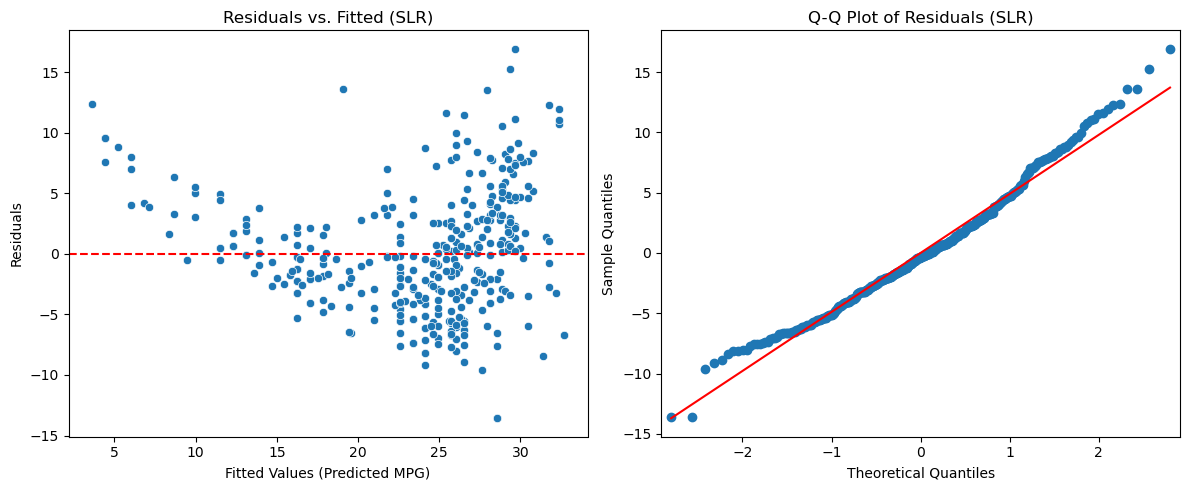
Residuals vs. Fitted (Left): This is a problem. The plot shows a clear “U-shape” (a non-linear pattern). This means our assumption of a linear relationship is wrong. Our model is underfitting.
Q-Q Plot (Right): The residuals also peel away from the line at the tails, suggesting the errors are not perfectly normally distributed.
Conclusion: The SLR model is simple and significant, but it’s fundamentally flawed because it fails the linearity assumption. We need a more complex model.
Multiple Linear Regression - The “Full” Model#
Let’s build a “full” model that includes all potential predictors. This will be our starting point for backward elimination.
Our formula will be:
mpg ~ cylinders + displacement + horsepower + weight + acceleration + model_year + C(origin)
Handling Categorical Variables: C(origin)#
The origin column is categorical (USA, Europe, Japan). If we just add origin to the model, statsmodels will treat it as a number, which is wrong.
By wrapping it in C(), we tell statsmodels to treat it as a Categorical variable. It will automatically:
Choose a “reference” level (by default, the lowest one, which in our case is Europe).
Create “dummy variables” for the other levels.
The output will show coefficients for C(origin)[T.japan] and C(origin)[T.usa]. These coefficients represent the difference in mpg compared to the Europe, holding all other variables constant.
# Define and fit the "Full" MLR model
all_features = 'mpg ~ cylinders + displacement + horsepower + weight + acceleration + model_year + C(origin)'
model_full = smf.ols(all_features, data=mpg_clean).fit()

# Print the full summary table
print(model_full.summary())
                            OLS Regression Results
==============================================================================
Dep. Variable:                    mpg   R-squared:                       0.824
Model:                            OLS   Adj. R-squared:                  0.821
Method:                 Least Squares   F-statistic:                     224.5
Date:                Sat, 01 Nov 2025   Prob (F-statistic):          1.79e-139
Time:                        14:51:20   Log-Likelihood:                -1020.5
No. Observations:                 392   AIC:                             2059.
Df Residuals:                     383   BIC:                             2095.
Df Model:                           8
Covariance Type:            nonrobust
======================================================================================
                         coef    std err          t      P>|t|      [0.025      0.975]
--------------------------------------------------------------------------------------
Intercept            -15.3246      4.602     -3.330      0.001     -24.374      -6.276
C(origin)[T.japan]     0.2232      0.566      0.394      0.694      -0.890       1.336
C(origin)[T.usa]      -2.6300      0.566     -4.643      0.000      -3.744      -1.516
cylinders             -0.4897      0.321     -1.524      0.128      -1.121       0.142
displacement           0.0240      0.008      3.133      0.002       0.009       0.039
horsepower            -0.0182      0.014     -1.326      0.185      -0.045       0.009
weight                -0.0067      0.001    -10.243      0.000      -0.008      -0.005
acceleration           0.0791      0.098      0.805      0.421      -0.114       0.272
model_year             0.7770      0.052     15.005      0.000       0.675       0.879
==============================================================================
Omnibus:                       23.395   Durbin-Watson:                   1.291
Prob(Omnibus):                  0.000   Jarque-Bera (JB):               34.452
Skew:                           0.444   Prob(JB):                     3.30e-08
Kurtosis:                       4.150   Cond. No.                     8.56e+04
==============================================================================

Notes:
[1] Standard Errors assume that the covariance matrix of the errors is correctly specified.
[2] The condition number is large, 8.56e+04. This might indicate that there are
strong multicollinearity or other numerical problems.
Interpreting the Full Model#
Adj. R-squared: 0.818. A massive improvement! Our model now explains 81.8% of the variance.Multicollinearity Warning:
statsmodelswarns us:The condition number is large... This might indicate that there is strong multicollinearity.P-Values: Look at the
P>|t|column. We see several variables with high p-values (>\(0.05\)):C(origin)[T.japan](p=0.694)cylinders(p=0.128)horsepower(p=0.185)acceleration(p=0.421)
These variables are not statistically significant in this specific model. This is due to multicollinearity. cylinders, horsepower, and acceleration are all measuring the same thing (engine power) and are redundant.
Backward Elimination#
Our full model is bloated and unreliable. We will use Backward Elimination to simplify it, creating a “parsimonious” model that is both accurate and interpretable.
The Process:
Fit the full model.
Find the predictor with the highest p-value > \(0.05\).
Remove that predictor.
Refit the model and go back to step 2.
Stop when all remaining predictors have \(p < 0.05\).
As a first step, we should remove C(origin)[T.japan] (p=0.694). However, this is one of the levels of origin, so we cannot just remove it. Instead, we can specify a different reference level than the default one to see if this improves things:
# Define and fit the "Full" MLR model
all_features = 'mpg ~ cylinders + displacement + horsepower + weight + acceleration + model_year + C(origin, Treatment(reference="usa"))'
model_full = smf.ols(all_features, data=mpg_clean).fit()

# Print the full summary table
print(model_full.summary())
                            OLS Regression Results
==============================================================================
Dep. Variable:                    mpg   R-squared:                       0.824
Model:                            OLS   Adj. R-squared:                  0.821
Method:                 Least Squares   F-statistic:                     224.5
Date:                Sat, 01 Nov 2025   Prob (F-statistic):          1.79e-139
Time:                        14:52:50   Log-Likelihood:                -1020.5
No. Observations:                 392   AIC:                             2059.
Df Residuals:                     383   BIC:                             2095.
Df Model:                           8
Covariance Type:            nonrobust
===================================================================================================================
                                                      coef    std err          t      P>|t|      [0.025      0.975]
-------------------------------------------------------------------------------------------------------------------
Intercept                                         -17.9546      4.677     -3.839      0.000     -27.150      -8.759
C(origin, Treatment(reference="usa"))[T.europe]     2.6300      0.566      4.643      0.000       1.516       3.744
C(origin, Treatment(reference="usa"))[T.japan]      2.8532      0.553      5.162      0.000       1.766       3.940
cylinders                                          -0.4897      0.321     -1.524      0.128      -1.121       0.142
displacement                                        0.0240      0.008      3.133      0.002       0.009       0.039
horsepower                                         -0.0182      0.014     -1.326      0.185      -0.045       0.009
weight                                             -0.0067      0.001    -10.243      0.000      -0.008      -0.005
acceleration                                        0.0791      0.098      0.805      0.421      -0.114       0.272
model_year                                          0.7770      0.052     15.005      0.000       0.675       0.879
==============================================================================
Omnibus:                       23.395   Durbin-Watson:                   1.291
Prob(Omnibus):                  0.000   Jarque-Bera (JB):               34.452
Skew:                           0.444   Prob(JB):                     3.30e-08
Kurtosis:                       4.150   Cond. No.                     8.70e+04
==============================================================================

Notes:
[1] Standard Errors assume that the covariance matrix of the errors is correctly specified.
[2] The condition number is large, 8.7e+04. This might indicate that there are
strong multicollinearity or other numerical problems.
Great, this solved the problem for origin! We note that we have the same adjusted R-squared value, so we did not harm or improve the regressor.
We now have the following high p-values:
cylinders(p=0.128)horsepower(p=0.185)acceleration(p=0.421)
Let’s remove acceleration next:
# Define and fit the "Full" MLR model
all_features = 'mpg ~ cylinders + displacement + horsepower + weight + model_year + C(origin, Treatment(reference="usa"))'
model_full = smf.ols(all_features, data=mpg_clean).fit()

# Print the full summary table
print(model_full.summary())
                            OLS Regression Results
==============================================================================
Dep. Variable:                    mpg   R-squared:                       0.824
Model:                            OLS   Adj. R-squared:                  0.821
Method:                 Least Squares   F-statistic:                     256.7
Date:                Sat, 01 Nov 2025   Prob (F-statistic):          1.49e-140
Time:                        14:54:35   Log-Likelihood:                -1020.8
No. Observations:                 392   AIC:                             2058.
Df Residuals:                     384   BIC:                             2089.
Df Model:                           7
Covariance Type:            nonrobust
===================================================================================================================
                                                      coef    std err          t      P>|t|      [0.025      0.975]
-------------------------------------------------------------------------------------------------------------------
Intercept                                         -16.3323      4.219     -3.871      0.000     -24.628      -8.037
C(origin, Treatment(reference="usa"))[T.europe]     2.6345      0.566      4.654      0.000       1.521       3.748
C(origin, Treatment(reference="usa"))[T.japan]      2.8574      0.552      5.172      0.000       1.771       3.944
cylinders                                          -0.5028      0.321     -1.568      0.118      -1.133       0.128
displacement                                        0.0234      0.008      3.070      0.002       0.008       0.038
horsepower                                         -0.0250      0.011     -2.320      0.021      -0.046      -0.004
weight                                             -0.0065      0.001    -11.209      0.000      -0.008      -0.005
model_year                                          0.7739      0.052     14.994      0.000       0.672       0.875
==============================================================================
Omnibus:                       25.943   Durbin-Watson:                   1.290
Prob(Omnibus):                  0.000   Jarque-Bera (JB):               39.879
Skew:                           0.468   Prob(JB):                     2.19e-09
Kurtosis:                       4.251   Cond. No.                     7.86e+04
==============================================================================

Notes:
[1] Standard Errors assume that the covariance matrix of the errors is correctly specified.
[2] The condition number is large, 7.86e+04. This might indicate that there are
strong multicollinearity or other numerical problems.
The adjusted R-squared is the same, but we now have the following high p-values:
cylinders(p=0.118)
Let’s remove cylinders:
# Define and fit the "Full" MLR model
all_features = 'mpg ~  displacement + horsepower + weight + model_year + C(origin, Treatment(reference="usa"))'
model_full = smf.ols(all_features, data=mpg_clean).fit()

# Print the full summary table
print(model_full.summary())
                            OLS Regression Results
==============================================================================
Dep. Variable:                    mpg   R-squared:                       0.823
Model:                            OLS   Adj. R-squared:                  0.820
Method:                 Least Squares   F-statistic:                     297.9
Date:                Sat, 01 Nov 2025   Prob (F-statistic):          2.80e-141
Time:                        14:55:29   Log-Likelihood:                -1022.0
No. Observations:                 392   AIC:                             2058.
Df Residuals:                     385   BIC:                             2086.
Df Model:                           6
Covariance Type:            nonrobust
===================================================================================================================
                                                      coef    std err          t      P>|t|      [0.025      0.975]
-------------------------------------------------------------------------------------------------------------------
Intercept                                         -17.5036      4.160     -4.207      0.000     -25.683      -9.324
C(origin, Treatment(reference="usa"))[T.europe]     2.5958      0.567      4.581      0.000       1.482       3.710
C(origin, Treatment(reference="usa"))[T.japan]      2.7722      0.551      5.033      0.000       1.689       3.855
displacement                                        0.0155      0.006      2.699      0.007       0.004       0.027
horsepower                                         -0.0230      0.011     -2.149      0.032      -0.044      -0.002
weight                                             -0.0066      0.001    -11.449      0.000      -0.008      -0.005
model_year                                          0.7749      0.052     14.986      0.000       0.673       0.877
==============================================================================
Omnibus:                       24.729   Durbin-Watson:                   1.275
Prob(Omnibus):                  0.000   Jarque-Bera (JB):               37.452
Skew:                           0.455   Prob(JB):                     7.37e-09
Kurtosis:                       4.211   Cond. No.                     7.73e+04
==============================================================================

Notes:
[1] Standard Errors assume that the covariance matrix of the errors is correctly specified.
[2] The condition number is large, 7.73e+04. This might indicate that there are
strong multicollinearity or other numerical problems.
The adjusted R-squared is a bit lower, but all p-values are below the threshold now!
Final Model Interpretation#
Now we have a final, parsimonious model.
Adj. R-squared: 0.820. We removed two variables and our model’s explanatory power is still just as high.All p-values are < 0.05. We can confidently interpret every coefficient.
Final Coefficient Analysis:
weight: -0.0066. “For every 1lb increase inweight,mpgdecreases by 0.0066, holding all other variables constant. (This is the net effect of increasing weight).model_year: 0.7749. “For each newermodel_year,mpgincreases by 0.78, holding all other variables constant. (Cars get more efficient over time).C(origin)[T.europe]: 2.5958. “A car fromEuropegets 2.6 more mpg than a car from theUSA, holding all other variables constant”.C(origin)[T.japan]: 2.7722. “A car fromJapangets 2.77 more mpg than a car from theUSA, holding all other variables constant”.
Final Diagnostic Check#
Our p-values and coefficients are only reliable if this final model is valid. Let’s check the residuals.
# --- SLR Diagnostic Plots ---
fitted_values_slr = model_slr.fittedvalues
residuals_slr = model_slr.resid

plt.figure(figsize=(12, 5))

# 1. Residuals vs. Fitted Plot
ax1 = plt.subplot(1, 2, 1)
sns.scatterplot(x=fitted_values_slr, y=residuals_slr, ax=ax1)
ax1.axhline(0, color='red', linestyle='--')
ax1.set_title('Residuals vs. Fitted (Simple Linear Regression)')
ax1.set_xlabel('Fitted Values (Predicted MPG)')
ax1.set_ylabel('Residuals')
ax1.set_ylim(-20, 20)

# 2. Q-Q Plot
ax2 = plt.subplot(1, 2, 2)
sm.qqplot(residuals_slr, line='s', ax=ax2) # 's' = standardized line
ax2.set_title('Q-Q Plot of Residuals (Simple Linear Regression)')

plt.tight_layout()
plt.show()

# --- Final Model Diagnostic Plots ---
fitted_values_final = model_full.fittedvalues
residuals_final = model_full.resid

plt.figure(figsize=(12, 5))

# 1. Residuals vs. Fitted Plot
ax1 = plt.subplot(1, 2, 1)
sns.scatterplot(x=fitted_values_final, y=residuals_final, ax=ax1)
ax1.axhline(0, color='red', linestyle='--')
ax1.set_title('Residuals vs. Fitted (Final Model)')
ax1.set_xlabel('Fitted Values (Predicted MPG)')
ax1.set_ylabel('Residuals')
ax1.set_ylim(-20, 20)

# 2. Q-Q Plot
ax2 = plt.subplot(1, 2, 2)
sm.qqplot(residuals_final, line='s', ax=ax2)
ax2.set_title('Q-Q Plot of Residuals (Final Model)')


plt.tight_layout()
plt.show()
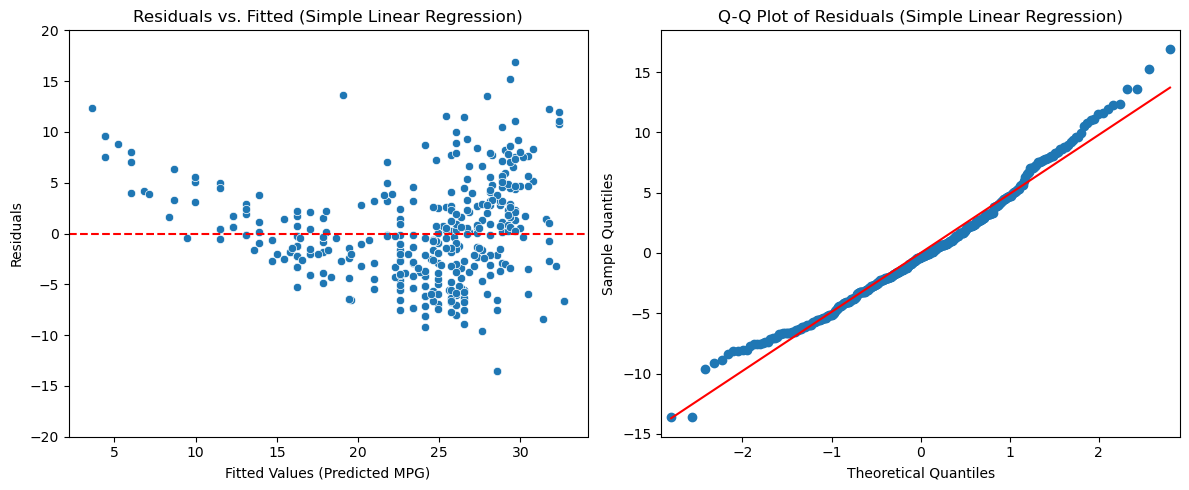
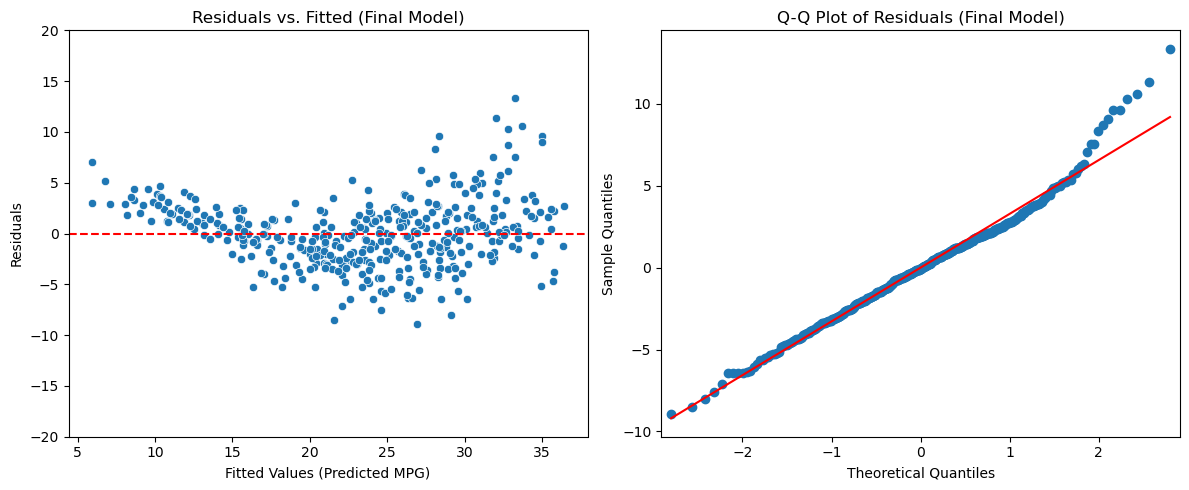
Residuals vs. Fitted (Left): This is a bit better. The problematic “U-shape” is still there but less pronounced.
Q-Q Plot (Right): This also looks a bit improved, with the points falling closer to the normal-distribution line in the left part of the plot.
Exercises#
Exercise 1
Consider the Titanic dataset. Calculate a linear regressor that predicts
Farevalues fromSurvived,Pclass,Sex, andAgevalues. Insert dummy variables where appropriate. Is the obtained regressor a good regressor? Which variables contribute significantly to the regression? Are there irrelevant variables? Eliminate these variables using the backward elimination technique. Discuss the meaning of the identified coefficients.
Exercise 2
Consider the Titanic dataset. Calculate a linear regressor that predicts
Agevalues fromSurvived,Pclass,Sex, andFarevalues. Insert dummy variables where appropriate. Is the obtained regressor a good regressor? Is it a better or worse regressor than the one calculated in the previous exercise? Which variables contribute significantly to the regression? Are there irrelevant variables? Eliminate such variables using the backward elimination technique. Discuss the meaning of the identified coefficients.
References#
Chapter 3 of [1]
Parts of chapter 11 of [2]
[1] Heumann, Christian, and Michael Schomaker Shalabh. Introduction to statistics and data analysis. Springer International Publishing Switzerland, 2016.
[2] James, Gareth Gareth Michael. An introduction to statistical learning: with applications in Python, 2023.https://www.statlearning.com